

If you’ve begun researching addiction treatment, for yourself or someone you love, you’ve likely come across terms like cognitive behavioral therapy, dialectical behavior therapy, evidence-based treatment, and therapeutic modalities. These phrases get used frequently in the treatment world, sometimes interchangeably, and often without enough explanation for the average person to understand what they actually mean in practice.
That lack of clarity matters. Because when you’re choosing a treatment program, understanding how your therapist is going to work with you is just as important as understanding where you’re going to receive care.
At Discovery Transitions Outpatient, our clinical team is trained in a wide range of evidence-based therapeutic approaches, including both dialectical behavior therapy (DBT) and cognitive behavioral therapy (CBT). In this article, we’re going to break down what each of these therapies actually is, explore the key differences in dialectical behavior therapy vs CBT, and explain how our clinicians use both, strategically and collaboratively, to support lasting recovery from drug and alcohol addiction.
What Is Cognitive Behavioral Therapy (CBT)?
Cognitive behavioral therapy is one of the most extensively researched and widely used psychological treatments in the world. Originally developed in the 1960s by psychiatrist Dr. Aaron Beck, CBT is built on a foundational premise: our thoughts, feelings, and behaviors are interconnected, and by changing the way we think, we can change the way we feel and act.
CBT is a structured, goal-oriented, and present-focused form of therapy. Rather than spending significant time exploring childhood experiences or unconscious processes (as psychodynamic therapies do), CBT zeroes in on the specific thoughts and behavioral patterns that are driving distress and dysfunction in a person’s current life.
The Core Framework of CBT
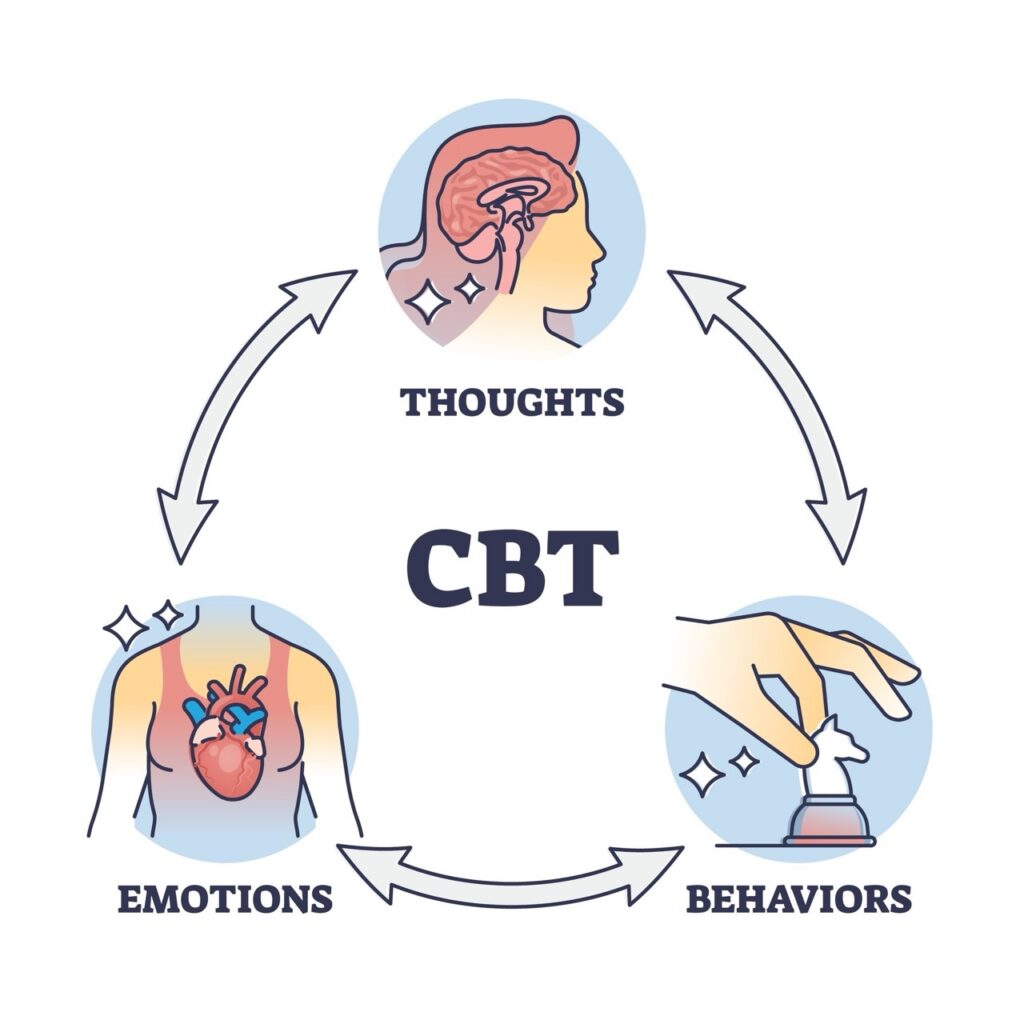
The central model in CBT involves what therapists often call the cognitive triangle, the relationship between:
- Thoughts (cognitions): What we believe about ourselves, others, and the world
- Feelings (emotions): The emotional responses those beliefs generate
- Behaviors: The actions we take in response to those thoughts and feelings
In addiction treatment, this triangle becomes critically important. Many individuals struggling with substance use have deeply entrenched automatic thoughts, often negative, distorted, or catastrophic, that fuel emotional distress, which in turn drives the urge to use substances as a way to cope.
CBT helps clients identify these cognitive distortions, patterns of thinking that are inaccurate or unhelpful, and replace them with more balanced, realistic perspectives. Common cognitive distortions seen in individuals with substance use disorders include:
- All-or-nothing thinking: “I had one drink, so I’ve already failed. I might as well keep going.”
- Catastrophizing: “If I can’t use, I won’t be able to handle anything.”
- Minimizing: “My drinking isn’t that bad compared to other people.”
- Emotional reasoning: “I feel like using, so I must need it.”
- Personalization: “Everything goes wrong because of me, what’s the point of trying?”
How CBT Is Applied in Addiction Treatment
In the context of substance use disorder treatment, CBT focuses on several core skills and strategies:
- Functional analysis: Identifying the triggers, thoughts, feelings, and consequences associated with substance use
- Coping skills training: Developing concrete strategies for managing cravings, stress, and high-risk situations
- Relapse prevention planning: Anticipating situations that increase risk and creating specific response plans
- Behavioral activation: Replacing substance use with meaningful, rewarding activities that support recovery
- Problem-solving skills: Building practical tools for navigating life challenges without turning to substances
CBT is typically delivered in a structured format with homework assignments, worksheets, and skill-building exercises between sessions. It is time-limited, highly practical, and focused on equipping clients with tools they can apply immediately in real life.
According to the National Institute on Drug Abuse (NIDA), CBT is one of the most well-supported behavioral interventions for substance use disorders, with strong evidence of effectiveness across multiple substances including alcohol, cocaine, marijuana, and opioids.
What Is Dialectical Behavior Therapy (DBT)?
Dialectical behavior therapy was developed in the late 1980s by psychologist Dr. Marsha Linehan, originally as a treatment for borderline personality disorder, particularly for individuals with chronic suicidal ideation and self-harm behaviors who had not responded to traditional CBT.
The word “dialectical” refers to the synthesis of opposites, most centrally, the balance between acceptance and change. DBT operates on the principle that clients need to be fully accepted and validated exactly as they are while simultaneously being supported and challenged to change the behaviors that are causing harm in their lives. This balance, accepting what is, while working toward something better, is at the philosophical heart of DBT.
Over the decades since its development, DBT has been extensively adapted and validated for a wide range of presentations, including substance use disorders, eating disorders, PTSD, depression, and anxiety. Its particular strength lies in helping individuals who experience emotional dysregulation, intense, rapidly shifting emotions that feel overwhelming and difficult to manage.
The Four Core Skill Modules of DBT
DBT is unique among evidence-based therapies in its structured, skills-based curriculum. The therapy is organized around four core skill modules, each addressing a specific dimension of emotional and behavioral functioning:
1. Mindfulness The foundation of all DBT skills. Mindfulness teaches clients to observe and describe their internal experiences, thoughts, emotions, physical sensations, without judgment and without being swept away by them. In addiction treatment, mindfulness is particularly powerful for building the capacity to notice a craving without immediately acting on it.
2. Distress Tolerance DBT recognizes that some painful situations cannot be immediately resolved, and that trying to escape or suppress distress through substance use only worsens the underlying problem over time. Distress tolerance skills teach clients how to survive crisis moments without making things worse, using techniques like TIPP (Temperature, Intense exercise, Paced breathing, Progressive relaxation), radical acceptance, and self-soothing strategies.
3. Emotion Regulation This module addresses the identification, understanding, and management of intense emotions. Clients learn to recognize what they are feeling and why, reduce vulnerability to emotional overwhelm, increase positive emotional experiences, and act opposite to destructive emotional urges.
4. Interpersonal Effectiveness Healthy relationships are both a cornerstone of recovery and a frequent source of stress and relapse triggers. This module teaches skills for assertive communication, setting and maintaining boundaries, asking for what you need, and saying no effectively, all while maintaining self-respect and relationships that matter.
DBT’s Relationship to Emotional Dysregulation and Addiction
The connection between emotional dysregulation and substance use is well-established in the clinical literature. Many individuals with substance use disorders report using alcohol or drugs as their primary, and sometimes only, strategy for managing overwhelming emotional states. Substances provide rapid, reliable (if temporary) relief from anxiety, depression, loneliness, shame, and emotional pain.
DBT directly targets this pattern by equipping clients with an entire toolkit of alternative coping strategies, increasing their capacity to tolerate distress without resorting to substances, and helping them build lives that feel genuinely worth living, what Dr. Linehan called a “life worth living.”
Dialectical Behavior Therapy vs CBT: Key Differences Explained
Now that we’ve established what each therapy is, let’s get into the heart of the question: when comparing dialectical behavior therapy vs CBT, what are the meaningful differences?
Both therapies are cognitive-behavioral in nature, they both emphasize the connection between thoughts, emotions, and behaviors, and both use structured skill-building as a primary intervention. However, several important distinctions set them apart.
1. Philosophical Foundation
CBT’s core philosophy emphasizes change, identifying problematic thoughts and behaviors and replacing them with more adaptive alternatives. The therapist is something of a collaborative guide and coach, helping clients dispute inaccurate beliefs and build better habits.
DBT introduces a critically important counterbalance: radical acceptance. Before change can happen, DBT insists that the client must first be fully accepted and validated, exactly as they are, in this moment. This dialectical tension (acceptance and change) distinguishes DBT philosophically from traditional CBT.
2. Target Population
CBT was designed and validated as a broadly applicable therapy for a wide range of psychological conditions, anxiety, depression, OCD, phobias, PTSD, and substance use disorders, among many others.
DBT was originally developed specifically for individuals with borderline personality disorder who experience chronic emotional dysregulation and self-destructive behavior. Its effectiveness with complex trauma, severe emotional dysregulation, and co-occurring personality disorders makes it particularly valuable in addiction treatment settings where these presentations are common.
3. Structure and Format
Standard CBT is typically delivered in individual therapy sessions, typically weekly, over a course of 12 to 20 sessions, with homework between sessions.
Full DBT, as developed by Dr. Linehan, involves four components: individual therapy, a skills training group, phone coaching (for crisis support between sessions), and a therapist consultation team. This comprehensive structure reflects the complexity of the populations DBT was designed to serve. In addiction treatment settings, DBT skills groups are commonly integrated into treatment programming alongside individual therapy.
4. Skills Content
While CBT focuses primarily on cognitive restructuring and behavioral strategies related to specific problem areas, DBT offers a comprehensive four-module skills curriculum (mindfulness, distress tolerance, emotion regulation, interpersonal effectiveness) that addresses broad emotional and relational functioning, not just the presenting problem.
5. Emphasis on the Therapeutic Relationship
Both CBT and DBT value a strong therapeutic alliance, but DBT places particular emphasis on the therapist’s validation and genuine acceptance of the client. DBT therapists are trained to find the kernel of truth and wisdom in even the most seemingly self-destructive behaviors, understanding them as logical responses to unbearable pain, before working to help clients find better paths forward.
DBT vs CBT: Side-by-Side Comparison
| Feature | CBT | DBT |
| Developed by | Dr. Aaron Beck (1960s) | Dr. Marsha Linehan (1980s) |
| Core philosophy | Change maladaptive thoughts and behaviors | Balance acceptance and change |
| Primary focus | Cognitive restructuring, behavioral change | Emotional regulation, distress tolerance |
| Format | Individual therapy, structured sessions | Individual therapy + skills group + coaching |
| Skills curriculum | Problem-specific coping tools | Four-module skills framework |
| Originally designed for | Broad range of conditions | Borderline PD, emotional dysregulation |
| Strength in addiction | Relapse prevention, trigger management | Emotional regulation, crisis tolerance |
| Therapeutic relationship | Collaborative coaching | Validation + change (dialectical balance) |
Why Both DBT and CBT Are Used in Addiction Treatment
Here is something that surprises many people when they first encounter the dialectical behavior therapy vs CBT question in the context of addiction treatment: the most effective clinical programs don’t choose one over the other. They use both, strategically, and in an integrated way, because addiction is a complex, multidimensional illness that rarely responds fully to a single therapeutic approach.
At Discovery Transitions Outpatient, our clinical team is trained across multiple evidence-based modalities. We don’t apply therapy from a fixed script, we assess each client individually and draw from the most appropriate tools for their specific needs, history, and presentation.
Here’s how the integration of CBT and DBT works in practice in our program:
CBT for Addiction: Building the Cognitive Foundation
CBT forms a strong structural backbone in our addiction treatment approach. From the very beginning of treatment, CBT-informed work helps clients:
- Identify and map their personal triggers, the people, places, emotions, and situations that create vulnerability to relapse
- Recognize the automatic thoughts and cognitive distortions that fuel cravings and justify substance use
- Develop a personalized relapse prevention plan with concrete, practiced responses for high-risk situations
- Build behavioral skills for managing stress, boredom, and conflict without substances
- Restructure unhelpful core beliefs about themselves, their capacity for change, and their worthiness of recovery
This work is highly practical and immediately applicable. Clients leave each session with tools they can use that very day.
DBT for Addiction: Building Emotional Resilience
DBT skills address what many people in recovery identify as the hardest part of getting sober: learning to feel your feelings without being destroyed by them. For individuals who have spent years using alcohol or drugs to manage emotional pain, building this capacity is not a simple cognitive exercise, it requires a comprehensive, practiced skill set.
DBT-informed work in our program helps clients:
- Develop a consistent mindfulness practice that creates space between emotional experience and impulsive reaction
- Build a toolkit of distress tolerance strategies for surviving crisis moments, cravings, and emotional flooding without using
- Identify and regulate the intense emotional states, anxiety, shame, anger, grief, loneliness, that most commonly drive substance use
- Improve the quality and health of their relationships, reducing a major source of emotional dysregulation and relapse risk
- Cultivate radical acceptance of past experiences, including trauma, loss, and regret, as a foundation for genuine forward movement
The Integrated Approach in Practice
In a typical week at Discovery Transitions Outpatient, a client might work with their individual therapist using CBT-informed techniques to restructure a specific thought pattern driving relapse risk, while simultaneously attending a group session where DBT distress tolerance and emotion regulation skills are being taught and practiced.
The two approaches reinforce each other in powerful ways. CBT helps clients understand why they think and behave the way they do, and provides concrete tools for change. DBT helps clients tolerate the discomfort of change itself, building the emotional resilience and crisis survival skills necessary to stay in recovery when life gets difficult.
This integration reflects a broader truth about effective addiction treatment: no single approach holds all the answers. The most effective programs are those that remain flexible, responsive, and genuinely individualized, drawing from the best available evidence to meet each person where they are.
The Role of Co-Occurring Mental Health Conditions
One of the primary reasons both DBT and CBT are so central to addiction treatment is the extraordinarily high rate of co-occurring mental health conditions among individuals with substance use disorders.
Research published by SAMHSA indicates that approximately 9.2 million adults in the United States experience both a mental health disorder and a substance use disorder simultaneously, what clinicians call a dual diagnosis or co-occurring disorder.
Common co-occurring conditions include:
- Major depression and persistent depressive disorder
- Generalized anxiety disorder and panic disorder
- Post-traumatic stress disorder (PTSD)
- Borderline personality disorder (BPD)
- Attention-deficit/hyperactivity disorder (ADHD)
- Bipolar disorder
- Social anxiety disorder
CBT has strong evidence for treating depression, anxiety, PTSD, and many other conditions alongside addiction. DBT was specifically designed for borderline personality disorder, complex trauma, and chronic emotional dysregulation, presentations that are extremely common in individuals with substance use disorders.
Treating addiction without simultaneously addressing co-occurring mental health conditions is one of the most significant predictors of relapse. At Discovery Transitions Outpatient, our on-site psychiatrist works alongside our therapy team to ensure that both dimensions of a client’s presentation are being addressed in a coordinated, integrated way.
What the Research Says: Evidence for DBT and CBT in Addiction Treatment
Both CBT and DBT have robust bodies of research supporting their effectiveness in addiction treatment, and the evidence continues to grow.
Evidence for CBT in Substance Use Disorders
CBT is among the most well-researched behavioral interventions for addiction. Key findings from the research literature include:
- Significant reductions in substance use across multiple substances including alcohol, cocaine, marijuana, and opioids
- Strong evidence for relapse prevention, the CBT relapse prevention model, developed by G. Alan Marlatt and Judith Gordon, remains one of the most widely used frameworks in addiction treatment
- Durability of effects, CBT skills, once learned, continue to provide benefit long after the conclusion of formal treatment
- Effectiveness in combination with medication-assisted treatment (MAT)
Evidence for DBT in Substance Use Disorders
Dr. Marsha Linehan and colleagues specifically developed a DBT adaptation for substance use disorders, DBT-SUD, which has demonstrated strong evidence in clinical trials. Key findings include:
- Significant reductions in drug use among individuals with borderline personality disorder and co-occurring substance use disorders
- Reductions in self-harm and suicidal behaviors, which frequently co-occur with addiction
- Improvements in emotional regulation, distress tolerance, and relationship functioning
- Strong evidence for reducing dropout from treatment, a critical challenge in addiction care
The National Institute on Drug Abuse (NIDA) recognizes both CBT and DBT-informed approaches as evidence-based components of comprehensive addiction treatment.
What to Expect in Therapy at Discovery Transitions Outpatient
If you’re considering treatment at Discovery Transitions Outpatient, you may be wondering what therapy actually looks like day-to-day. Here is an honest picture of the therapeutic experience our clients can expect:
Initial Assessment and Treatment Planning
Every client begins with a comprehensive intake assessment conducted by their assigned therapist. This assessment explores substance use history, mental health history, trauma history, relational and social circumstances, and personal goals for recovery. Within the first few days, the full multidisciplinary team, including the therapist, psychiatrist, and clinical staff, collaborates with the client to build a comprehensive, individualized treatment plan.
Individual Therapy Sessions
Clients meet with their primary therapist one to two times per week. Sessions are collaborative, goal-oriented, and grounded in evidence-based approaches, including CBT and DBT, as well as other modalities our therapists are trained in. The focus of each session is responsive to where the client is in their recovery process at that moment.
Group Therapy and Skills Groups
Group sessions provide an opportunity to learn and practice skills, including DBT skill modules, in a community setting with peers who understand the recovery experience. Group therapy also reduces isolation, builds accountability, and helps clients develop the interpersonal skills that are so essential to long-term sobriety.
Psychiatric Care
Our on-site psychiatrist is available to address medication-related needs, diagnose and manage co-occurring psychiatric conditions, and provide ongoing psychiatric support throughout the treatment process. Clients typically meet with the psychiatrist within their first week and regularly thereafter as clinically indicated.
Weekly Treatment Plan Reviews
Every client’s treatment plan is reviewed and updated weekly by the full clinical team. Recovery is not a linear process, and treatment should evolve in response to where each client is at any given moment. This ongoing review process ensures that care remains genuinely individualized and clinically responsive throughout the entire course of treatment.
Is DBT or CBT Right for You?
If you’re asking whether dialectical behavior therapy vs CBT is the right choice for your specific situation, the honest answer is: that determination is best made by a qualified clinician who can conduct a thorough assessment of your history, needs, and goals.
What we can tell you is that at Discovery Transitions Outpatient, you won’t be handed a one-size-fits-all treatment model. Our therapists are trained across multiple modalities and are committed to meeting each client where they are, drawing from the best available tools to support their individual recovery journey.
Whether your primary struggles are cognitive (unhelpful thinking patterns, deeply held negative beliefs), emotional (overwhelming feelings, difficulty tolerating distress), behavioral (patterns of avoidance or impulsivity), relational (conflict, codependency, isolation), or some combination of all of the above, our clinical team has the training and the commitment to meet you there.
Recovery is not a destination you arrive at by following someone else’s map. It is a deeply personal journey, and the therapy you receive along the way should reflect that.
Frequently Asked Questions: Dialectical Behavior Therapy vs CBT for Addiction
1. What is the main difference between DBT and CBT?
The core difference between dialectical behavior therapy vs CBT lies in both philosophy and focus. CBT is primarily oriented toward identifying and changing maladaptive thoughts and behaviors, helping clients recognize cognitive distortions and replace them with more realistic, functional thinking. DBT, while also cognitive-behavioral in nature, introduces a critical philosophical counterbalance: radical acceptance. DBT insists that genuine, lasting change must be built on a foundation of full acceptance of who you are and where you are right now. DBT also offers a more comprehensive emotional skills curriculum, covering mindfulness, distress tolerance, emotion regulation, and interpersonal effectiveness, making it particularly valuable for individuals who experience intense emotional dysregulation alongside addiction.
2. Is DBT or CBT more effective for addiction treatment?
Both therapies have strong evidence supporting their effectiveness in addiction treatment, and direct comparisons between them are limited by the complexity of the populations studied. Rather than one being universally “more effective” than the other, the key is clinical match: CBT tends to be particularly effective for relapse prevention, cognitive restructuring, and coping skills development. DBT is especially effective for individuals who experience co-occurring emotional dysregulation, borderline personality disorder, chronic trauma, or severe distress intolerance. Many high-quality addiction treatment programs, including Discovery Transitions Outpatient, integrate both approaches, drawing on the complementary strengths of each to provide more comprehensive care.
3. Can DBT and CBT be used together in addiction treatment?
Yes, and at Discovery Transitions Outpatient, this integrated approach is exactly what we practice. CBT and DBT are not mutually exclusive; they are complementary. CBT provides the cognitive and behavioral framework for understanding and changing thought patterns and behaviors associated with substance use. DBT provides the emotional regulation and distress tolerance skills necessary to sustain those changes when life becomes difficult. Used together, they address addiction from multiple angles simultaneously, making the combined approach more robust than either therapy alone for many individuals.
4. How long does DBT or CBT take to work for addiction?
The timeline for meaningful therapeutic benefit varies significantly based on the individual, the severity of their substance use disorder, the presence of co-occurring conditions, and their engagement with the therapeutic process. CBT-based relapse prevention skills can often produce meaningful results relatively quickly, many clients report using coping strategies within the first few weeks of treatment. DBT skills take time to learn and internalize, the full DBT skills curriculum typically runs over approximately six months in standard format, though meaningful benefit from individual skills (particularly mindfulness and distress tolerance) can be experienced much sooner. At Discovery Transitions Outpatient, treatment duration is fully individualized, there are no arbitrary timelines, only what your recovery actually requires.
5. What other therapies does Discovery Transitions Outpatient use alongside DBT and CBT?
Our clinical team is trained in a variety of evidence-based therapeutic modalities beyond DBT and CBT. Depending on individual clinical needs, our therapists may incorporate motivational interviewing (MI) to strengthen intrinsic motivation for change, trauma-informed approaches for clients with significant trauma histories, acceptance and commitment therapy (ACT), 12-step facilitation, and family systems approaches. Our on-site psychiatrist also provides medication-assisted treatment (MAT) where clinically appropriate. The guiding principle is always individualization, the best therapy is the one that fits you, not the one that happens to be on a standardized protocol.
Begin Your Recovery Journey with Discovery Transitions Outpatient
Recovery is possible. Not easy, but absolutely possible. And it is far more achievable when you have the right clinical support behind you.
At Discovery Transitions Outpatient, we bring together the most effective evidence-based therapies, including dialectical behavior therapy, cognitive behavioral therapy, and a range of other proven approaches, in a compassionate, individualized outpatient program designed to help you build lasting recovery while maintaining the responsibilities and relationships that matter to you.
Our multidisciplinary clinical team includes an on-site psychiatrist, licensed therapists trained across multiple modalities, and a collaborative care team committed to reviewing and updating your treatment plan every week. Because your recovery deserves that level of attention.
Discovery Transitions Outpatient 📍 Van Nuys, California 📞 (818) 824-5022) 🌐 discoverytransitions.com
Call today for a confidential consultation. You don’t have to have it all figured out before you reach out, that’s what we’re here for.